Vocaber vs Rosetta Stone: Immersion Lessons or Swift Vocabulary Review?
Would you rather work out a phrase’s meaning from context, or check it directly and move on to the words you need to practice?
Rosetta Stone builds its core lessons around immersion: learning through the target language and contextual clues. Vocaber uses a different review loop: read a French sentence, reveal its translation, and mark the words you did not know.
Both use context. The choice is between an immersion-style course and a focused vocabulary tool that keeps reviews moving.
Vocaber vs Rosetta Stone at a Glance
| Rosetta Stone | Vocaber | |
|---|---|---|
| Main approach | Immersion-style language lessons | Dedicated French vocabulary review |
| Understanding meaning | Context clues in target-language lessons | Try the sentence, then reveal the translation |
| Session structure | A Learning Path with units, lessons, and skill activities | A continuous flow of short sentence flashcards |
| Vocabulary practice | Lesson activities and separate flashcard sets | Multiple vocabulary words reviewed together in a sentence |
| Review tracking | Course and practice features vary by activity | Independent spaced repetition for each word |
| Pronunciation | TruAccent speech recognition | Not the focus of the vocabulary review loop |
| Producing language | Speaking activities and Chat Missions | Reverse-direction sentence output practice |
| Best fit | Learners who want immersion-style instruction | French learners who know the basics and want fluid vocabulary practice |
Rosetta Stone’s Learning Path guide describes its core lesson method and pronunciation tools. Its product overview covers flashcards and other features, while the Chat Missions page explains conversation practice.
What Rosetta Stone Offers
Rosetta Stone’s Learning Path organizes study into units, lessons, and activities covering different skills. Its Dynamic Immersion method uses contextual clues rather than constantly providing translations. TruAccent adds speech-recognition feedback during speaking practice.
That approach may appeal to you if you enjoy figuring out meaning through French itself and want a course to guide your study.
The current product also goes beyond the core lessons. Rosetta Stone advertises flashcard sets and Sapphire Studio for creating learning activities. Chat Missions provide scenario-based conversation practice with goals and feedback.
So the choice is not simply “pictures or flashcards.” It is about which part of language learning you want your next tool to handle.
Vocaber Makes the Meaning Explicit
In Vocaber, you first try to understand a sentence without help:
Elle a rangé les assiettes dans le placard.
She put the plates away in the cupboard.
Then you reveal the translation. If assiettes was familiar but rangé and placard were not, you mark the words you missed.
You do not have to keep guessing what the whole scene means. The translation gives you a clear check, and your attention can return to the vocabulary.
That is useful when you already understand basic French structure and want more encounters with unfamiliar words, rather than a lesson introducing the structure itself.
Swift Does Not Mean Superficial
A review can be demanding without requiring a long sequence of interactions. Vocaber keeps the mechanics simple:
- Read and try to understand.
- Reveal the meaning.
- Tap the words you did not know.
- Continue.
Easy sentences can move quickly. Difficult ones can take longer. You do not need to complete a typed answer or select from distractors just to confirm that you understood.
Tests can feel rigid when the required answer is not the part you found difficult. Vocaber lets you identify that difficulty directly, inside the sentence.
The goal is less friction between useful encounters with French, not rushing through words you have not learned.
The Vocabulary Adapts; the Sentence Changes
Vocaber’s flashcards are not a fixed stack of example sentences. Vocabulary words have review histories, and fresh sentences bring due words together for practice.
If assiettes is easy but placard is difficult, they can follow different schedules even after appearing in the same sentence. Your feedback changes when each word needs another review.
The sentence is there to supply context, not to receive one shared remembered-or-forgotten rating. Later, a word can appear with different surrounding vocabulary in a fresh sentence.
That is the adaptive part of the flow: your changing vocabulary needs shape the review material.
See the Vocaber walkthrough for the full review process.
Pronunciation, Conversation, and Recall Are Different Tasks
Rosetta Stone’s pronunciation tool helps you practice how words sound. Its Chat Missions ask you to work toward goals in a simulated interaction. Those features are relevant when speaking practice is what you want from a session.
Vocaber’s output practice asks a different question: can you retrieve the French from an English prompt? Try the sentence, reveal the answer, and identify the words that need more work.
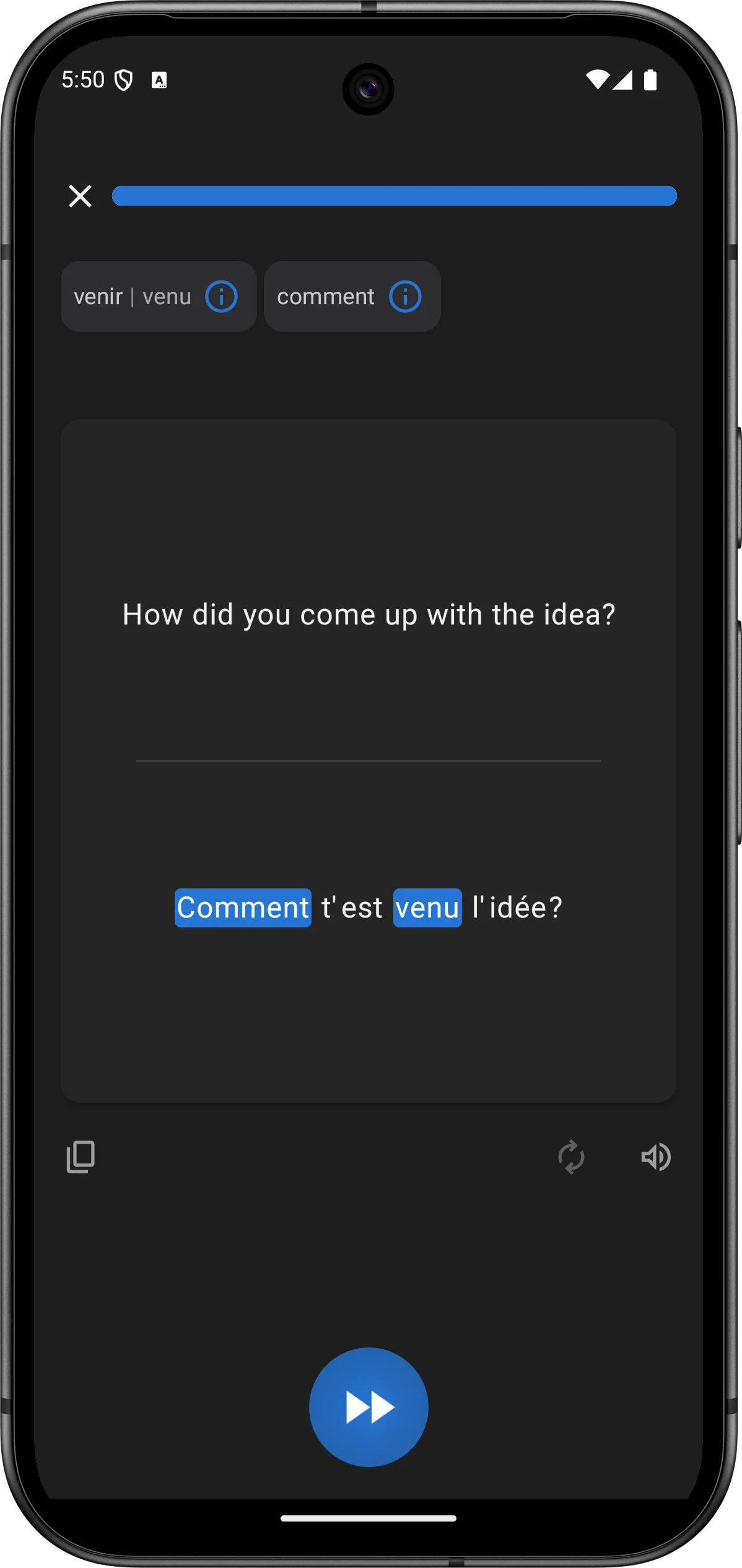
Choose according to the gap you notice. If you know a word but struggle to pronounce it, add pronunciation practice. If its meaning only comes back after seeing the answer, give recall more attention.
Our free French pronunciation tool can help you explore vowel sounds alongside vocabulary study.
Which Should You Choose?
Choose Rosetta Stone if you want a broader learning program and prefer its immersion-first lesson style. Try a sample to see whether learning through contextual clues suits you.
Choose Vocaber if you already know some French and want a focused vocabulary workflow: a direct meaning check, individual word feedback, and fresh sentences without assembling your own deck.
You can also separate the jobs. Use course activities for broader study and Vocaber for dedicated review. Then read or listen to French outside both apps, starting with a podcast for intermediate learners if you need a manageable next step.
The Verdict
Rosetta Stone offers an immersion-style course and a broader set of practice tools. Vocaber concentrates on swift, adaptive vocabulary review.
If you want to check meaning clearly, mark exactly what you missed, and keep working through fresh French sentences, try Vocaber.
Vocaber is available on Android. Check Google Play for current subscription terms and availability.

For other approaches, explore our French learning app comparison, Vocaber vs Babbel, and Vocaber vs Memrise.