Vocaber vs Babbel: French Lessons or Focused Vocabulary Review?
Do you need someone to explain how French works, or do you need more of the words that make it work?
Babbel gives you structured lessons with explanations and practice. Vocaber focuses on a narrower task: expanding your French vocabulary through swift, adaptive sentence reviews.
If you already understand basic sentence structure but keep reaching for a dictionary, a dedicated vocabulary tool may be a more useful next step than another general lesson.
Vocaber vs Babbel at a Glance
| Babbel | Vocaber | |
|---|---|---|
| Main purpose | A structured French course | Focused French vocabulary growth |
| Grammar | Explanations within lessons | Encountered in sentences; not a grammar course |
| Review material | Words and phrases from completed lessons | Due vocabulary combined into fresh sentences |
| Spaced repetition | Schedules lesson vocabulary based on review performance | Independent scheduling for each word |
| Review format | Flashcards, writing, speaking, and listening modes | Read, reveal the translation, mark unfamiliar words, and continue |
| Feedback | Depends on the exercise or review mode | Identify which words in the sentence need more practice |
| Producing French | Speaking exercises with speech recognition | Reverse-direction sentence output practice |
| Best fit | Learners who want a course and explanations | Learners who know the basics and want fluid vocabulary reviews |
Babbel’s French course overview describes its lesson approach. Its help center explains vocabulary review and speech recognition.
Where Babbel Helps
Babbel makes sense when you want guidance through French rather than a vocabulary tool alone. Lessons connect language practice with explanations, including grammar and practical usage.
That matters if your difficulty is understanding why a sentence takes a particular form. More vocabulary will not, by itself, explain an unfamiliar construction.
Babbel also includes pronunciation exercises using speech recognition. You listen to a model, repeat a word or phrase, and receive feedback. That is a different activity from trying to recall a sentence’s vocabulary.
Babbel Has Vocabulary Review Too
Finishing a Babbel lesson adds vocabulary to its review system. Review timing responds to your previous answers, and you can choose flashcards, writing, speaking, or listening activities.
You can also organize learned vocabulary into custom collections. The help center says the available words and phrases come from completed lessons rather than arbitrary words you add yourself.
So this is not a comparison between an app with spaced repetition and one without it. It is a choice between review attached to a course and a dedicated sentence-based vocabulary workflow.
How Vocaber Changes the Review
Vocaber brings several words that need practice into one sentence:
Nous avons marché jusqu’à la maison avec notre voisin.
We walked to the house with our neighbor.
Read for meaning, reveal the translation, and tap the words you did not know. You might recognize maison immediately but hesitate over marché and voisin.
Each word keeps its own review history. Understanding part of the sentence does not mean rating every word as learned, and forgetting one word does not mean treating all of them as forgotten.
The sentence gives the words context; it is not the item being scheduled. Later reviews bring vocabulary together in fresh sentences as individual words become due.
Swift Practice Without a Rigid Test Sequence
A lesson can be useful precisely because it slows you down to explain or test something. But when you already understand the structure and simply want more vocabulary exposure, that same rhythm can feel cumbersome.
Vocaber keeps its core loop short:
- Try to understand the sentence.
- Reveal its meaning.
- Mark what you missed.
- Continue.
You do not have to turn every sentence into a typed answer or a multiple-choice question. Easy material can move quickly; difficult vocabulary gets your attention.
The flashcards adapt through your feedback. As each word’s schedule changes, the mix of vocabulary available for future sentences changes too. The practice follows what needs work, rather than keeping you inside a fixed sequence of test questions.
For a closer look, see how Vocaber’s French vocabulary practice works.
What About Recall and Speaking?
Vocaber’s output practice starts with an English prompt. Try to produce the French sentence, reveal the answer, and identify which words caused difficulty.
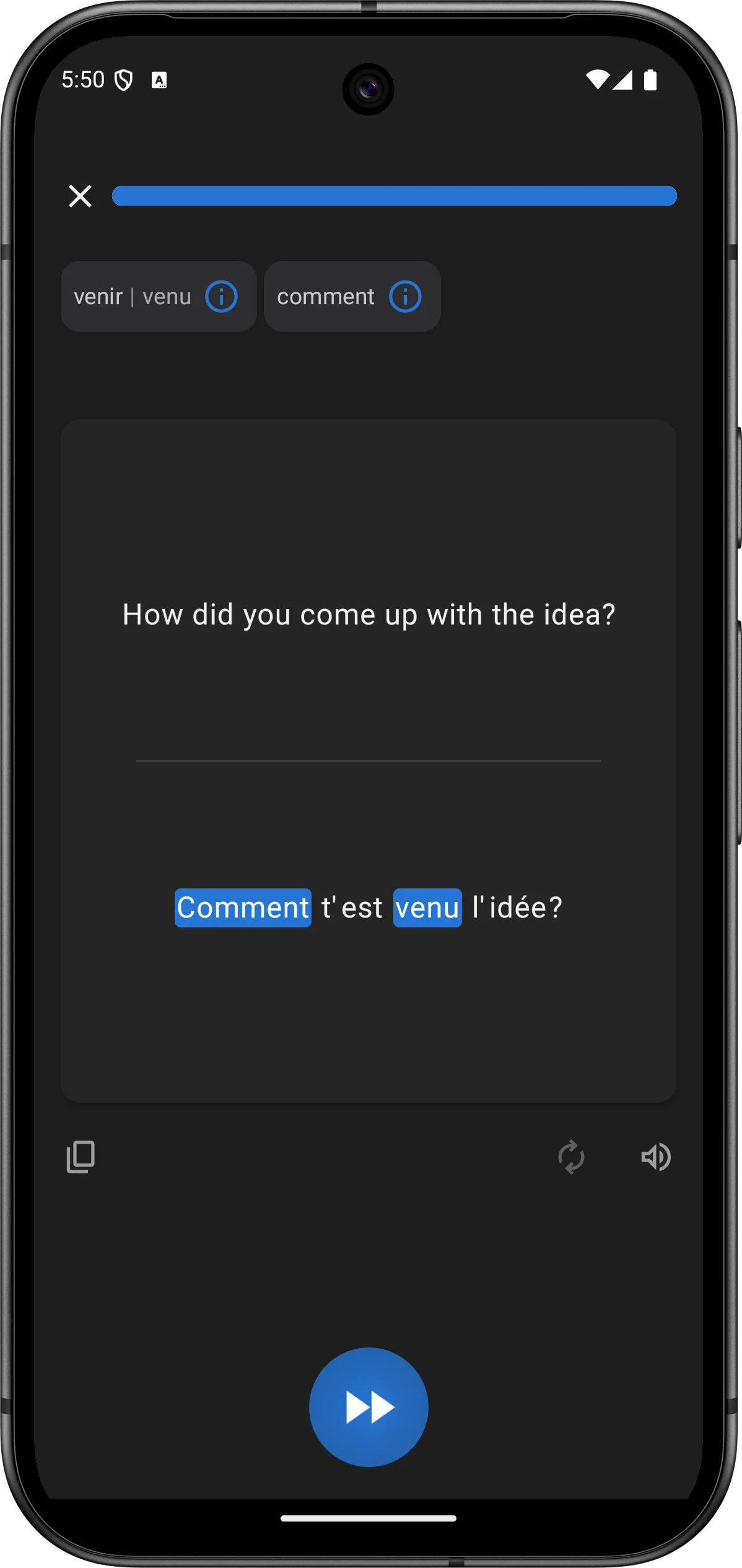
That is useful when recognizing a French word feels easier than retrieving it yourself. It is not the same task as pronunciation feedback or conversation. Choose practice that addresses the gap you actually notice.
If pronunciation is the obstacle, try our free French pronunciation practice. If conversation is the goal, make time to speak with another person alongside app practice.
Which Should You Choose?
Choose Babbel if you want a course with explanations, particularly when grammar and sentence structure still need guided practice. Its combination of lessons and review keeps those activities in one product.
Choose Vocaber if you know the basics and want more French vocabulary without building a deck or working through another course. Its focus is fresh sentence context, several words per review, and a fluid read-and-reveal rhythm.
Use both if they have different jobs. Babbel can provide the course while Vocaber handles dedicated vocabulary practice. Then put that vocabulary to use in a French podcast for intermediate learners or something you enjoy reading.
The Verdict
Babbel helps you work through French lessons. Vocaber helps you keep vocabulary review moving.
When explanations are what you need, choose a course. When unfamiliar words are the bottleneck, try a focused review tool that adapts to those words.
Vocaber is available on Android. Check Google Play for current subscription terms and availability.

For other approaches, explore our French learning app comparison, Vocaber vs Duolingo, and Vocaber vs Anki.