Vocaber vs Duolingo: Which Should You Use for French?
You can finish a French lesson and still get stuck on the first paragraph of a French article. If the sentence structure makes sense but unfamiliar words keep interrupting you, another general lesson may not be what you need next.
That is where Vocaber fits. Duolingo provides a structured language course. Vocaber focuses on expanding French vocabulary through fresh sentences, with a separate review schedule for each word.
The question is not which app wins at everything. It is whether you need a course to follow or more vocabulary to work with.
Vocaber vs Duolingo at a Glance
| Duolingo | Vocaber | |
|---|---|---|
| Main purpose | A structured language course | Focused French vocabulary practice |
| Starting point | Start from scratch or use placement | Already know basic French sentence structure |
| Study format | Short lessons organized into course units | Sentences containing multiple vocabulary words to review |
| Vocabulary review | Course practice and a Words option in the Practice tab | Independent spaced repetition for every word |
| Your response | Complete the exercise presented in the lesson | Understand a sentence, check the translation, and mark unfamiliar words |
| Grammar | Taught alongside vocabulary in course units | Encountered in context; not a grammar course |
| Producing French | Writing and speaking activities | Reverse-direction sentence output practice |
| Cost model | Free courses with optional paid subscriptions | Subscription; see current terms on Google Play |
Duolingo describes its course structure in its learning guide, targeted review in its Practice tab overview, and free access in its pricing-model explanation.
What Duolingo Gives You
Duolingo organizes vocabulary and grammar around communication goals. Its lessons include reading, listening, writing, and speaking activities. You can begin at the start or use placement to skip familiar material.
That structure is useful when you want the app to decide what comes next. You do not have to assemble a curriculum yourself.
It also offers more than the main lesson path. Duolingo’s Practice tab includes words, mistakes, listening, and speaking practice, with free skill sessions on its mobile apps. If a particular skill needs attention, explore those options before assuming you need a different app.
What Vocaber Does Differently
Vocaber starts with words that need practice and combines several of them in a sentence:
Nous avons marché jusqu’à la maison avec notre voisin.
We walked to the house with our neighbor.
Read for meaning, check the translation, and tap the words you did not know. Perhaps maison was obvious, but marché and voisin were not. Each word keeps its own review history.
You do not have to treat the whole sentence as one success or failure. A familiar word and a difficult word can follow different schedules, even when they appear together.
The sentence provides context for the review. Later, the vocabulary can appear in a different sentence rather than returning as a fixed card. Output practice reverses the direction: try to produce a French sentence from an English prompt before checking the answer.
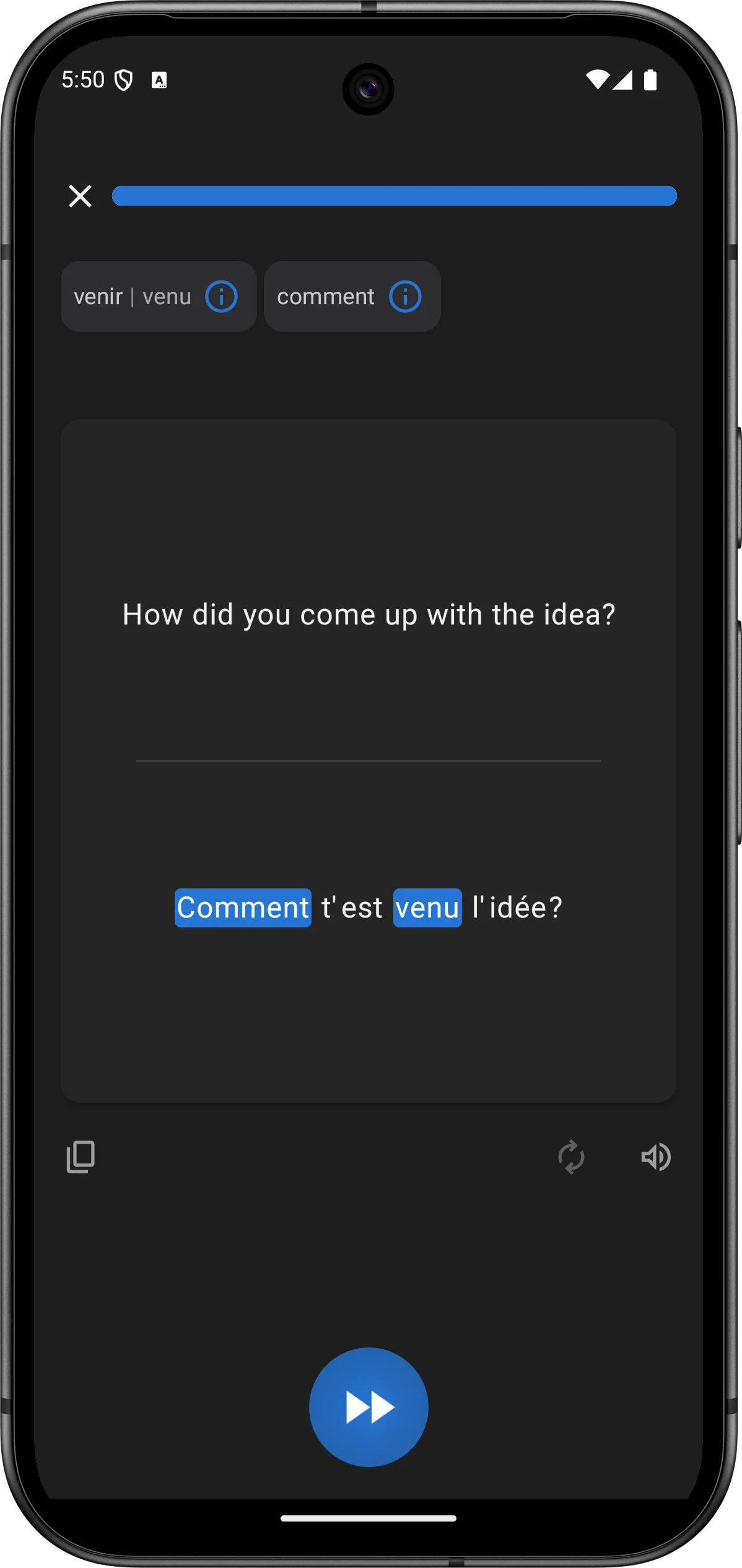
See the French vocabulary walkthrough for the full review flow.
Is Vocaber a Good App After Duolingo?
It can be, particularly if you recognize this situation: you understand how a French sentence works, but you keep stopping to look up words.
Try a short passage from a French podcast for intermediate learners or an article on a familiar topic. Ask what is actually blocking you:
- Unfamiliar words: focused vocabulary practice is a useful next step. This is Vocaber’s purpose.
- Unclear sentence structure: keep working with a course, teacher, or French grammar reference.
- Words you recognize in writing but miss in speech: add listening and French pronunciation practice.
- Difficulty responding in conversation: make room for speaking with another person, not only app exercises.
You do not need to finish every Duolingo unit before adding vocabulary practice. Choose by the difficulty you encounter outside the app, not just your position on a lesson path.
When to Choose Duolingo
Choose Duolingo if you want a guided course, especially when you are still establishing the basics. Its short lessons, streaks, and rewards may help you maintain a regular habit. Free course access also makes it an option when you do not want a subscription.
A consistent habit is useful. Give it an outside check: can you understand a little more French, follow a conversation more easily, or express something you could not say before?
When to Choose Vocaber
Choose Vocaber if your priority is more vocabulary in context, rather than another broad course. It is designed for learners who already know the basics and want a ready-to-use review workflow.
You review several words in a sentence, identify exactly what you missed, and return to those words as they become due. The aim is to spend your practice time working with French vocabulary rather than creating decks or designing exercises.
Vocaber is available on Android. Check its store listing for current subscription terms and availability.

Can You Use Both?
Yes. Keep Duolingo for course progression and use Vocaber for focused vocabulary review. Give them different jobs rather than adding more exercises simply to fill your study time.
Then use the language outside both apps. Read a short passage, listen to a native French podcast, or have a conversation. Notice whether the words you practice are becoming easier to recognize and recall.
The Verdict
Duolingo gives you a course. Vocaber gives you focused French vocabulary practice.
If you need guidance through the foundations, start with a course. If vocabulary is now the bottleneck, Vocaber is a Duolingo alternative worth trying, or a supplement to the lessons you already enjoy.
For other approaches, see our French learning app comparison, Vocaber vs Anki, and Clozemaster alternative.