Practice French Pronunciation for Free
You can hear that French tu and tout are different words. The trouble starts when you say them yourself. Something sounds off, and it is hard to tell which part of the sound to move.
Formaant puts that on a chart. Record a vowel and the app plots it next to a French reference. Shift one thing, record again, and you can see whether the dot actually moved.
The tool is free and runs in your browser. Record with your microphone, or load an audio file you already have.
Open the Free Pronunciation Tool
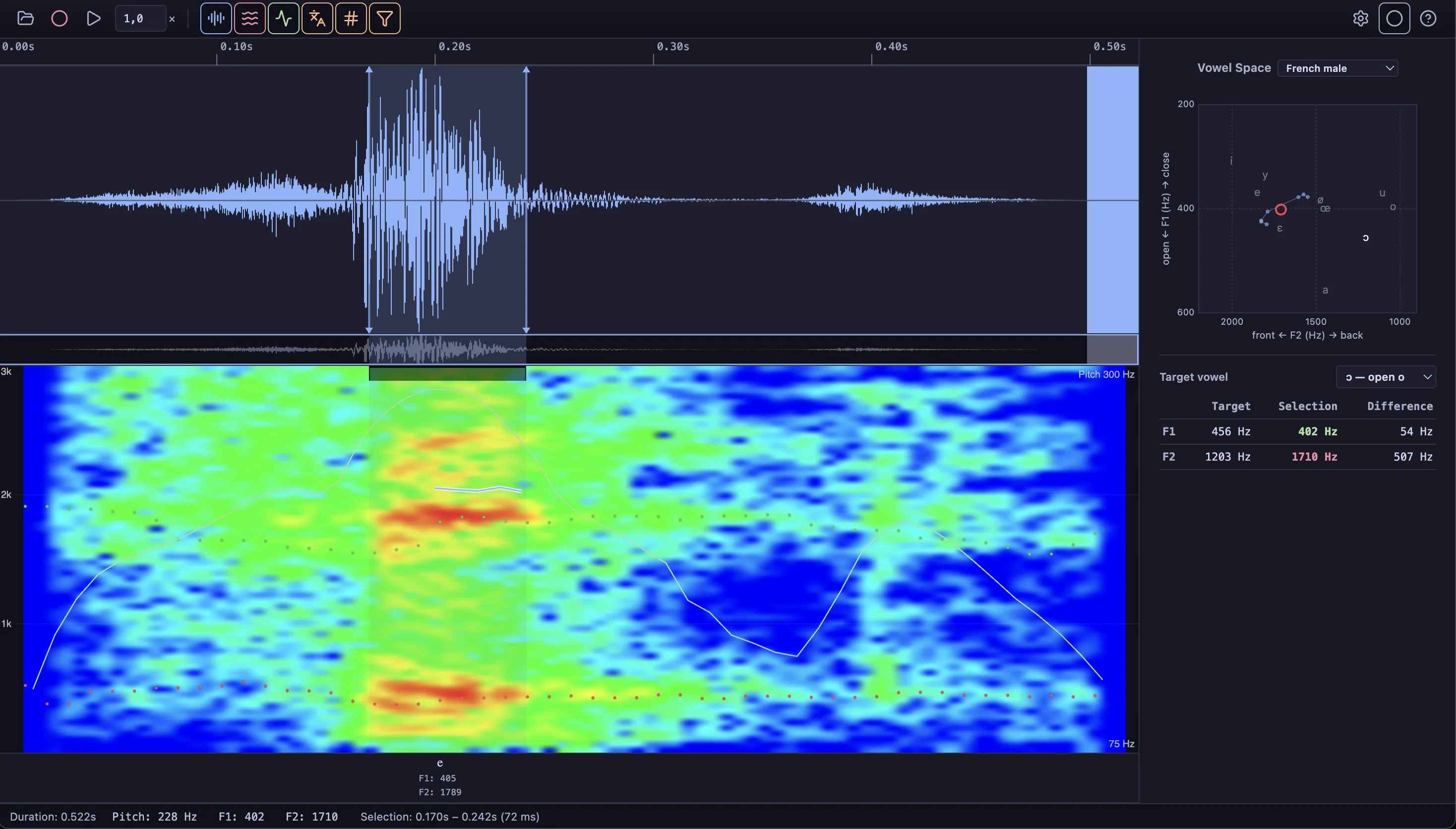
See What Your Vowels Are Doing
A vowel is the shape of your mouth while your voice is sounding. That shape sets up resonance bands called formants. Two of them do most of the work when you are practicing vowels:
- F1 follows how open the vowel is. A closed vowel such as /i/ has a low F1. An open vowel such as /a/ has a high one.
- F2 follows how far forward the tongue is. Front vowels have a high F2, and back vowels have a low one. Rounding your lips pulls F2 down as well.
Plot the two together and you get a vowel space: a map of your vowels against each other. The axes are flipped, so the chart lines up roughly with tongue position. Closed front vowels land toward the upper left.
Two takes that felt the same in your ear can sit in clearly different places. Once they are both on the chart, you can see which way you moved.
Start with Five Minutes of French Vowel Practice
- Open Formaant and choose a French profile. French male and female references are in the Vowel Space panel. Read them as a map of the layout. Another person’s voice will sit in a slightly different place, and so will yours.
- Record one steady vowel. Start with /i/, the vowel in si. Hold it for a short moment. A full sentence goes by too fast to read.
- See where it landed. Compare your dot with the reference. Inside a word, look at the steady middle of the vowel, after you have left the consonant and before you head into the next one.
- Change one thing, then record again. Do this a few times. A pattern across several takes is worth more than a single measurement.
- Then try words. si, ses, sait, sa, su, and sous keep the consonants similar, so the vowels are easier to compare.
Two Contrasts Worth Trying
French U and OU: /y/ vs /u/
tu is /ty/ and tout is /tu/. Both vowels are closed and rounded. /y/ sits much farther forward, and that distance shows up in F2. If your tu keeps sliding toward tout, the F2 of /y/ drops.
Say /i/ - /y/ - /u/ slowly. For /y/, keep the tongue where it was for /i/ and round your lips. Record a handful of each before you change anything else.
French E Sounds: /e/ vs /ɛ/
The vowel in ses is /se/, and the vowel in sait is /sɛ/. /ɛ/ is the more open of the two, so look at F1.
Try /i/ - /e/ - /ɛ/ - /a/ and watch the dots step down the chart. Different French accents draw this line in different places, so use the pair to practice hearing and producing the contrast.
For more word pairs, see our French minimal-pairs practice.
The Rest of the Tool
The vowel chart is one view. You can also inspect the waveform, spectrogram, pitch, formants, and intensity, from a fresh recording or from a file you load. The app adds automatic IPA labels, F1/F2 comparisons, and a place to save your own vowel profiles.
French is one of the reference profiles. There are also profiles for British and American English, Mandarin, Japanese, and Serbian. The app is open source, and it started from Web Praat, the browser port of Praat. The Formaant source and the reference-profile sources are on GitHub.
How to Read the Chart
Formant numbers differ from voice to voice. A consonant on either side will tug the vowel around, and the tracker sometimes locks onto the wrong frequency. When a point looks strange, listen to the take and check the spectrogram. Trust the pattern that shows up more than once.
Oral vowels are the straightforward case for a vowel-space plot. French nasal vowels have a more complicated acoustic shape, and F1 and F2 leave much of that out.
For a fuller walkthrough, read how to measure and improve your French pronunciation.
Try It with Your Own Voice
Start with one vowel. Record it a few times, then change a single thing. What you want from this is a feel for the difference, and enough control to produce it on purpose.