How to Measure and Improve Your French Pronunciation
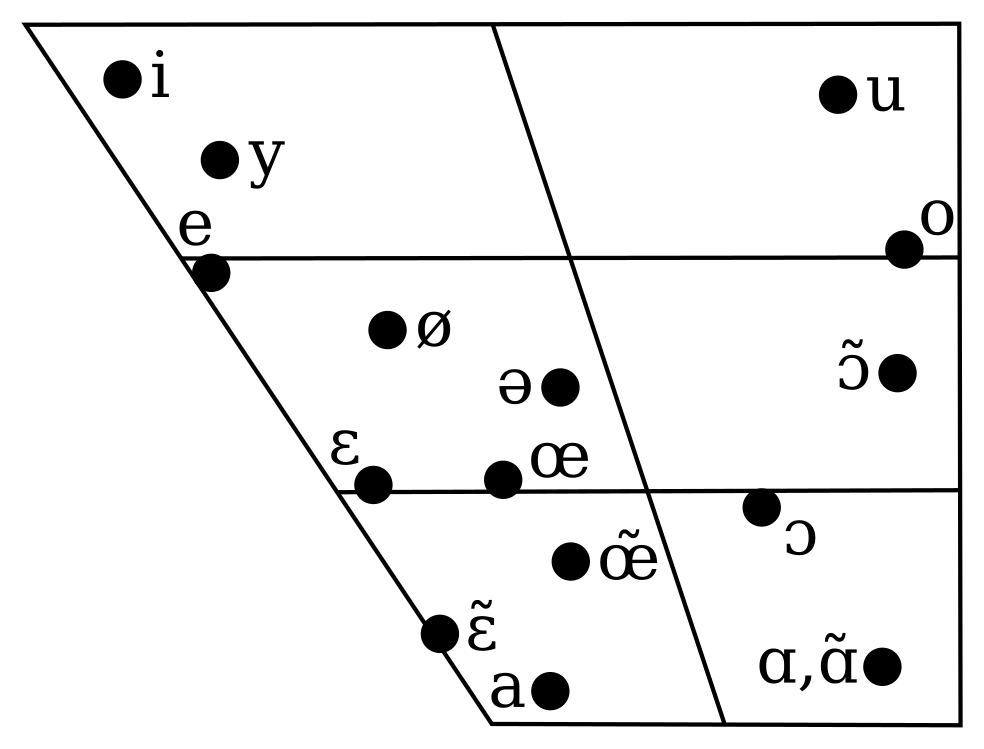
French vowel pronunciation can be measured acoustically using formants: frequency bands created by the resonances of the vocal tract.
For pronunciation work, the most useful are F1 and F2.
- F1 is closely related to vowel height. Lower F1 usually corresponds to a more closed vowel, while higher F1 corresponds to a more open vowel.
- F2 is closely related to frontness. Higher F2 usually corresponds to a more front vowel, while lower F2 corresponds to a more back vowel.
Plotting F1 against F2 gives you a vowel space: a map of where vowels sit relative to one another.
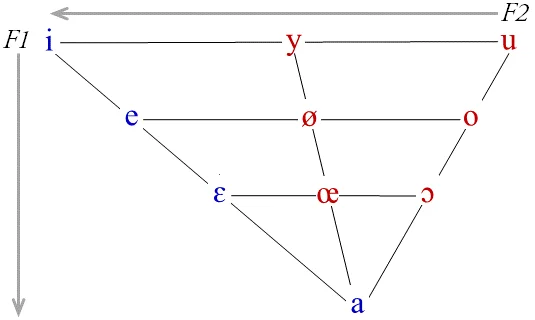

The axes are usually reversed so the chart roughly corresponds to tongue position in the mouth. Closed/front vowels such as /i/ appear toward the upper left, while open vowels such as /a/ appear lower down.
Moving vertically mostly corresponds to opening or closing the vowel, while moving horizontally mostly corresponds to moving the tongue forward or backward.
You can record and plot your own vowels in our free browser app Formaant.
Vowel Space
A vowel space makes it easier to see the relationship between French vowels.
Vowels such as /i/, /y/ and /u/ are all relatively closed, but differ in frontness and lip rounding. More open vowels such as /ɛ/ and /a/ appear lower in the chart.

The exact position varies between speakers, but the overall layout is useful for seeing which direction a vowel is moving.
Interpreting F1 and F2
If F1 is too high, the vowel is probably too open.
If F1 is too low, it is probably too closed.
If F2 is too low, the vowel is probably too far back.
If F2 is too high, it is probably too far forward.
For example, if your French /e/ keeps drifting toward /ɛ/, look at F1 first.
If your /y/ in tu starts approaching /u/, F2 is especially useful.
Practice
Start with isolated vowels and hold each one for a moment.
A useful sequence is:
/i/ — /e/ — /ɛ/ — /a/
Then compare:
/i/ — /y/ — /u/
Record several attempts and look at where they cluster.
If the result is consistently displaced in one direction, make a small adjustment and record again.
- F1 too high → close the vowel slightly
- F1 too low → open it slightly
- F2 too low → move the tongue forward
- F2 too high → move it back
Once the isolated vowel is stable, move on to words and short phrases.
Using similar consonant environments makes comparison easier. Words such as si, ses, sait, sa, su, and sous are useful because the surrounding sounds remain fairly similar.
Speaker Variation
Formant values vary between speakers, so the reference should be treated as a comparison point rather than a fixed target.
The relative position of your vowels is often more useful than an exact numerical match.
If your whole vowel space is shifted slightly from the reference, that may simply reflect your voice. A single vowel repeatedly falling into the area of another vowel is more significant.
Coarticulation
The same vowel can shift depending on the sounds around it.
Neighboring consonants affect tongue and lip position through coarticulation, and connected speech usually produces less stable measurements than isolated vowels.
When comparing recordings, use the same word or phrase where possible. Inside a word, measure the more stable middle part of the vowel rather than the transition into the surrounding consonants.
Tracking Errors
Automatic formant detection can occasionally lock onto the wrong frequency.
If a result looks implausible, check the spectrogram and record the vowel again. Several similar measurements are more useful than one outlier.
Nasal Vowels
French nasal vowels are harder to interpret using a simple F1/F2 plot because nasalization changes the acoustic structure of the vowel.
You can still inspect them, but vowel space is most straightforward for oral vowels.
Conclusion
Formants give you a practical way to measure French vowel pronunciation.
F1 mainly reflects how open or closed the vowel is, while F2 mainly reflects how front or back it is. Plotting them together gives you a vowel space that makes pronunciation differences easier to see.
Use the measurements for direction and comparison rather than exact matching. Record several attempts, look for consistent patterns, adjust, and repeat.
Different speakers naturally have different values, surrounding sounds can shift the measurement, and automatic tracking can occasionally fail.