Vocaber vs Memrise: Which Fits Your French Vocabulary Practice?
Watching someone use a French phrase and recalling the words yourself are different kinds of practice. You may want both, but not necessarily in the same session.
Memrise combines vocabulary learning with speaker videos and conversation activities. Vocaber concentrates on a swift flashcard flow: review several words in a sentence, check the meaning, mark what you missed, and continue.
If you are looking for a Memrise alternative for French, start with the kind of practice you want more of: a mix of learning activities or focused vocabulary review that keeps moving.
Vocaber vs Memrise at a Glance
| Memrise | Vocaber | |
|---|---|---|
| Main approach | Vocabulary learning with speaker videos and conversation activities | Short sentence-based vocabulary reviews |
| Context | Practical scenarios, example sentences, and video | Fresh sentences containing multiple words to practice |
| Review | Spaced repetition for learned words and sentences | Independent spaced repetition for each vocabulary word |
| Main interaction | Work through learning, review, video, and conversation activities | Understand, reveal the translation, mark unfamiliar words, and continue |
| Producing French | AI-supported conversation and other production activities | Reverse-direction sentence output practice |
| Custom material | Custom word lists in the current product | A prepared French vocabulary workflow |
| Best fit | Learners who want a mix of vocabulary, video, and speaking activities | French learners who want fluid reviews without assembling a deck |
Memrise describes its video and scenario approach on its French course page. Its FAQ explains review and lesson activities, and its word-list guide covers custom content.
What Memrise Does Well
Memrise connects vocabulary with people using the language. Its French offering includes native-speaker videos, practical scenarios, and AI-supported speaking practice.
That variety can be attractive if you want to hear how a phrase sounds, see a speaker deliver it, and then try using French yourself. Video adds something a written translation cannot: a visible person, pronunciation, and delivery.
Its lesson system also mixes activities such as learning, review, videos, and conversations. If switching between these activities helps you stay engaged, that breadth may be exactly what you want.
What Vocaber Prioritizes Instead
Vocaber narrows the task. You open a review, work through a sentence, and give feedback on the vocabulary inside it.
Nous avons marché jusqu’à la maison avec notre voisin.
We walked to the house with our neighbor.
You might understand maison instantly but hesitate over marché or voisin. After checking the translation, tap the words you did not know. Their review schedules remain separate.
Several words share a sentence, not one success-or-failure rating. You keep the context while telling the app exactly where you need more practice.
Swift Reviews, Not a Sequence of Tests
There are times when you want to type an answer, watch a clip, or work through a conversation. There are also times when those interactions feel like extra steps between you and the vocabulary.
Vocaber’s review rhythm stays simple:
- Read and try to understand.
- Reveal the translation.
- Mark the words you missed.
- Continue.
An easy sentence need not become a drawn-out exercise. A difficult one can take as much attention as it needs. The aim is to remove friction, not to rush your thinking.
Tests can feel rigid when you have to complete the required answer even though your uncertainty lies elsewhere in the sentence. Vocaber puts your feedback at word level, so identifying that uncertainty is part of the normal review flow.
Adaptation Means More Than Repeating a Card
Memrise also uses spaced repetition. The distinction is not that one app adapts and the other does not; it is how Vocaber builds the review around your vocabulary.
In Vocaber, words keep their own histories while their sentence context changes. As your feedback changes which words are due, those words can be brought together in new sentences. You are not simply working through a fixed stack of example sentences.
That gives the flashcards their fluid character: the vocabulary determines the next review material, rather than a fixed exercise determining which words you happen to practice.
See the Vocaber walkthrough for more about the review process.
Recognition vs Producing French
Understanding a French sentence and producing one from an English prompt are different demands. Vocaber includes both directions: input practice for comprehension and output practice for trying to recall the French before revealing it.
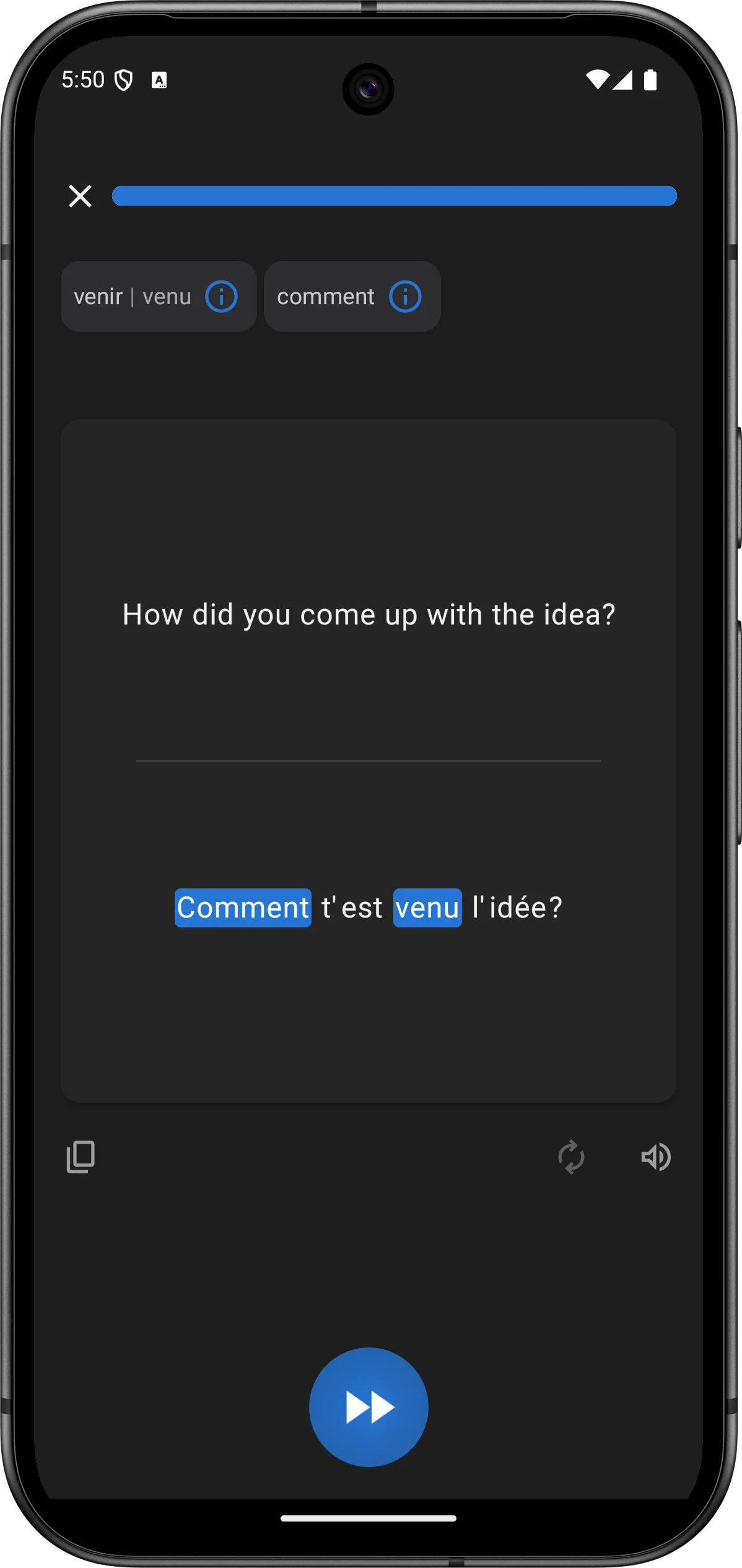
Memrise’s conversation activities serve a different purpose: practicing an exchange rather than checking your recall of a particular sentence. Choose that format when conversation is what you want to work on; choose focused review when vocabulary is the immediate obstacle.
Coming Back to Memrise After a Break?
Be clear about which version you remember. Older community courses moved to a separate site in 2024. Memrise’s current word-list guide says it began bringing user-created content back into the main product as custom word lists in 2026.
Those new lists and the older community-course archive are not the same thing. If your priority is studying a particular list you created or saved, check the current custom-content options before choosing your next tool.
Which Should You Choose?
Choose Memrise if speaker videos and a mix of learning and conversation activities are a major part of what you want from an app. Its custom word lists also matter if choosing your own vocabulary is important to you.
Choose Vocaber if you already know basic French and want focused vocabulary practice with fewer interruptions. Its strength is the combination of fresh sentence context, individual word schedules, and a quick read-and-reveal loop.
You can also use the apps for different purposes, or pair Vocaber with French podcasts for intermediate learners. Let the activity match the skill you want to practice rather than duplicating every task in multiple apps.
The Verdict
Memrise offers a broader mix of video, vocabulary, and conversation. Vocaber keeps sentence-based vocabulary review focused and fluid.
If your priority is opening an app and getting straight to the words you need to practice, try Vocaber. It is available on Android; check Google Play for current subscription terms and availability.

For other approaches, explore our French learning app comparison, Vocaber vs LingQ, and Vocaber vs Anki.