Vocaber vs Drops: Visual Vocabulary or Fluid Sentence Review?
Recognizing a picture of a window and understanding a sentence about opening one are different demands. If familiar French words still trip you up in actual sentences, your next step may be a change in review format.
Drops makes vocabulary practice visual and game-like. Vocaber brings multiple words into fresh sentences, with a quick meaning check and a separate review schedule for each word.
Both can fit a short study break. The choice is what you want that break to contain: visual vocabulary activities or a fluid sequence of sentence reviews.
Vocaber vs Drops at a Glance
| Drops | Vocaber | |
|---|---|---|
| Main format | Illustrated vocabulary and game-like activities | Short sentence-based flashcards |
| Material organization | Topic collections called Packs | Vocabulary brought together as it becomes due |
| Context | Visual associations and contextual Quiz Mode | Fresh sentences containing several words to review |
| Spaced repetition | Review Dojo schedules word practice | Each word has its own review history and schedule |
| Feedback | Complete the activity presented | Check the translation and mark the words you did not know |
| Recall practice | Varies with the activity | Input practice and reverse-direction sentence output practice |
| Best fit | Learners who enjoy visual, topic-led practice | French learners who know the basics and want more sentence-level vocabulary practice |
Drops describes its activities on its French learning page, topic organization in its Packs guide, and scheduled review in its Dojo documentation.
Where Drops Fits
Drops connects vocabulary with illustrations and native-speaker audio. Its activities include contextual quizzes and pronunciation practice, so the current app goes beyond simply matching a word to a picture.
The visual style can be appealing when you want an approachable way to encounter unfamiliar vocabulary. Images give concrete words a recognizable cue, and game-like interactions give the session a clear rhythm.
Its topic collections, called Packs, organize material by interests and categories. Free learners progress through topics within each Pack; Premium allows more freedom to jump between them.
That suits a goal such as exploring travel vocabulary or working through a particular topic. Vocaber starts somewhere else: with vocabulary that needs review, rather than a collection you want to complete.
Why Move from Words to Sentences?
A word can feel familiar when the same cue appears, yet take more effort to recognize among other words. Sentence practice makes you work with its meaning alongside verbs, articles, and surrounding vocabulary.
For example:
Il a fermé la fenêtre avant de sortir.
He closed the window before going out.
You may know fenêtre immediately but need to check fermé or sortir. Vocaber lets you mark those words separately after revealing the translation.
The whole sentence does not need one shared result. You can understand most of it and still identify the exact words that need another encounter.
Swift Practice Without Constant Testing
Drops and Vocaber both make room for short sessions. Vocaber’s emphasis is on keeping the vocabulary interaction itself simple:
- Read the French sentence.
- Try to understand it before revealing the translation.
- Tap the words you missed.
- Continue.
You do not need to answer a separate question for every word. Several vocabulary items can share one meaningful sentence while retaining individual review histories.
Tests can feel cumbersome when completing the required interaction takes more attention than the vocabulary. Vocaber favors a continuous read-and-reveal flow: move quickly when the sentence is easy and pause when something needs work.
Swiftness means removing unnecessary steps, not guessing faster. The translation gives you a check; your feedback tells the app where to focus future practice.
Both Use Spaced Repetition. What Changes?
Drops’ Review Dojo uses spaced repetition to decide which words need practice. It can also tell you when no review is currently needed.
Vocaber combines individual word scheduling with changing sentence context. As you mark unfamiliar words, their review histories change. Future reviews bring due vocabulary together in fresh sentences rather than returning to a fixed stack of sentence cards.
In the example above, fenêtre and sortir do not have to follow the same schedule. Each remains a separate vocabulary item even though you reviewed them together.
The distinction is how the scheduled practice is delivered: Vocaber makes a sentence the setting for several reviews, not the item being scheduled.
See the Vocaber walkthrough for more about the review flow.
Understanding French vs Producing It
Recognizing a word after seeing it is one task. Retrieving the French from an English prompt is another.
Vocaber’s output practice reverses the direction. Try to produce the French sentence first, reveal the answer, and identify which words caused difficulty.
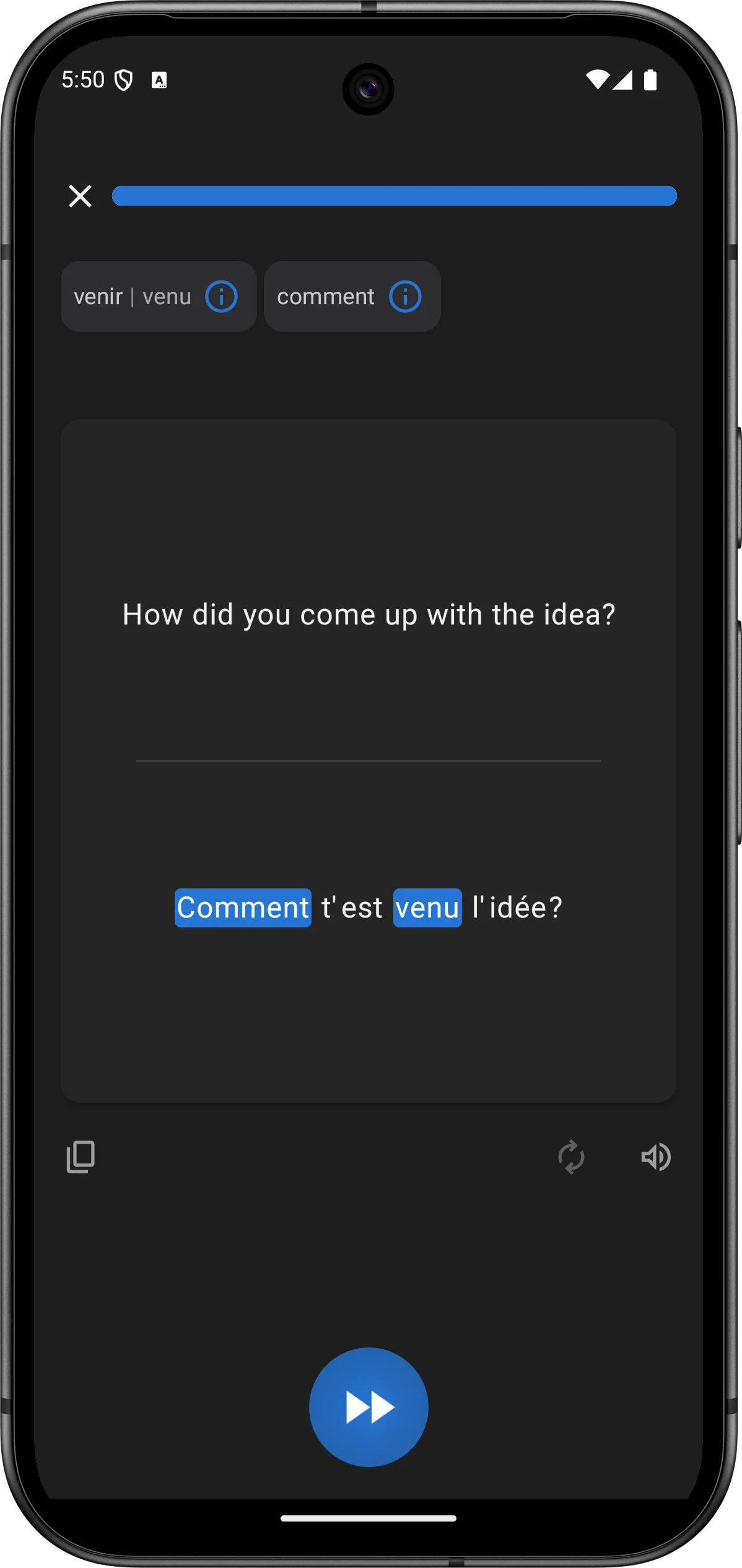
If you recognize plenty of French vocabulary but struggle to recall it yourself, that reverse-direction practice gives your session a different purpose from recognition alone.
Which Should You Choose?
Choose Drops if illustrations and game-like activities help you keep practicing, or you want to explore vocabulary by topic. Its French page describes a free five-minute daily allowance, making it an option to sample before paying.
Choose Vocaber if you already know basic French and want to work with vocabulary inside sentences. It is designed for learners who prefer quick meaning checks, individual word feedback, and fresh contexts without building a deck.
You can also keep visual practice for introducing words and use sentence review for a different kind of encounter. Then put the vocabulary to work in reading or a French podcast for intermediate learners.
The Verdict
Drops makes vocabulary visual and topic-led. Vocaber makes sentence review fluid and adaptive.
If your priority is moving through fresh French sentences while giving each word the review it needs, try Vocaber.
Vocaber is available on Android. Check Google Play for current subscription terms and availability.

For other approaches, explore our French learning app comparison, Vocaber vs Memrise, and Vocaber vs Anki.