Vocaber vs MosaLingua: Prepared Flashcards or Fresh Sentence Reviews?
You want spaced repetition without spending your evenings building flashcards. Both Vocaber and MosaLingua address that need, but the review experience is different.
MosaLingua offers prepared vocabulary and phrase cards alongside broader learning tools. Vocaber brings several words into a fresh sentence, lets you check the meaning, and tracks your recall of each word independently.
The choice is not whether to use repetition. It is what you want each repetition to look like.
Vocaber vs MosaLingua at a Glance
| MosaLingua | Vocaber | |
|---|---|---|
| Starting point | Prepared words, phrases, and flashcards | Vocabulary that needs practice |
| Review format | Selected cards with spaced repetition | Fresh sentences combining several vocabulary words |
| Context | Phrases, dialogues, and other learning material | Sentence context changes around the words being reviewed |
| What you assess | Recall of the card’s content | Which individual words you did not know in the sentence |
| Scheduling | Spaced repetition for vocabulary cards | An independent schedule for each vocabulary word |
| Broader practice | Lessons, pronunciation activities, and MosaChat-AI | Focused input and reverse-direction output reviews |
| Best fit | Learners who want prepared cards and a wider learning toolkit | French learners who want fluid, sentence-based vocabulary practice |
MosaLingua’s French app overview describes its vocabulary focus. Its current app page outlines flashcards, review, and additional learning tools.
Why Consider MosaLingua?
MosaLingua provides vocabulary and expressions to study without starting from an empty deck. You can choose cards and revisit them through spaced repetition, with native-speaker audio supporting the material.
Its current offering also includes lessons, dialogues, original-language content, and conversation practice with MosaChat-AI. That breadth is relevant if you want several learning activities in one product, rather than a vocabulary review loop alone.
If choosing prepared words and phrases is how you like to organize practice, MosaLingua is a natural option to explore.
Vocaber Changes the Unit of Practice
Vocaber keeps the review history at word level but combines vocabulary inside sentences:
Elle a prêté son vélo à son voisin.
She lent her bike to her neighbor.
Read the sentence and try to understand it before revealing the translation. You might know vélo immediately, hesitate over voisin, and miss prêté entirely.
You mark the words you did not know. Each word keeps its own schedule, even though you encountered them together.
Several reviews can share a sentence without sharing a single recall rating. That is the important difference from simply making a flashcard longer or adding an example to its back.
Fresh Sentences, Not Just Repeated Examples
A phrase or sentence can be useful study material. But recognizing a familiar example is not always the same as recognizing its vocabulary somewhere new.
Vocaber treats the sentence as temporary context. As words become due, fresh sentences bring vocabulary together for another encounter. Your feedback changes each word’s review history rather than scheduling the whole sentence as one card.
That means the practice can keep adapting as your knowledge changes. A word that has become easy and one you still forget do not need to stay tied to the same example or review interval.
See the Vocaber walkthrough for more about the review process.
Swift Reviews with Less Exercise Overhead
Both apps are built to make regular practice approachable. Vocaber’s particular focus is the rhythm between one useful sentence and the next:
- Read and try to understand.
- Reveal the translation.
- Tap the words you missed.
- Continue.
You do not have to type an answer or complete a multiple-choice test for every encounter. An easy sentence can move quickly; a difficult word can get more attention.
Tests can feel cumbersome when the required answer is not the part you found uncertain. Word-level feedback lets you identify that uncertainty directly, then get back to the language.
Swiftness comes from keeping the mechanics out of the way, not from skipping recall. You still try before revealing the answer and honestly mark what you did not know.
What About Producing French?
Vocaber’s input practice starts with French and checks understanding. Output practice reverses the direction: try to produce the French sentence from an English prompt before checking it.
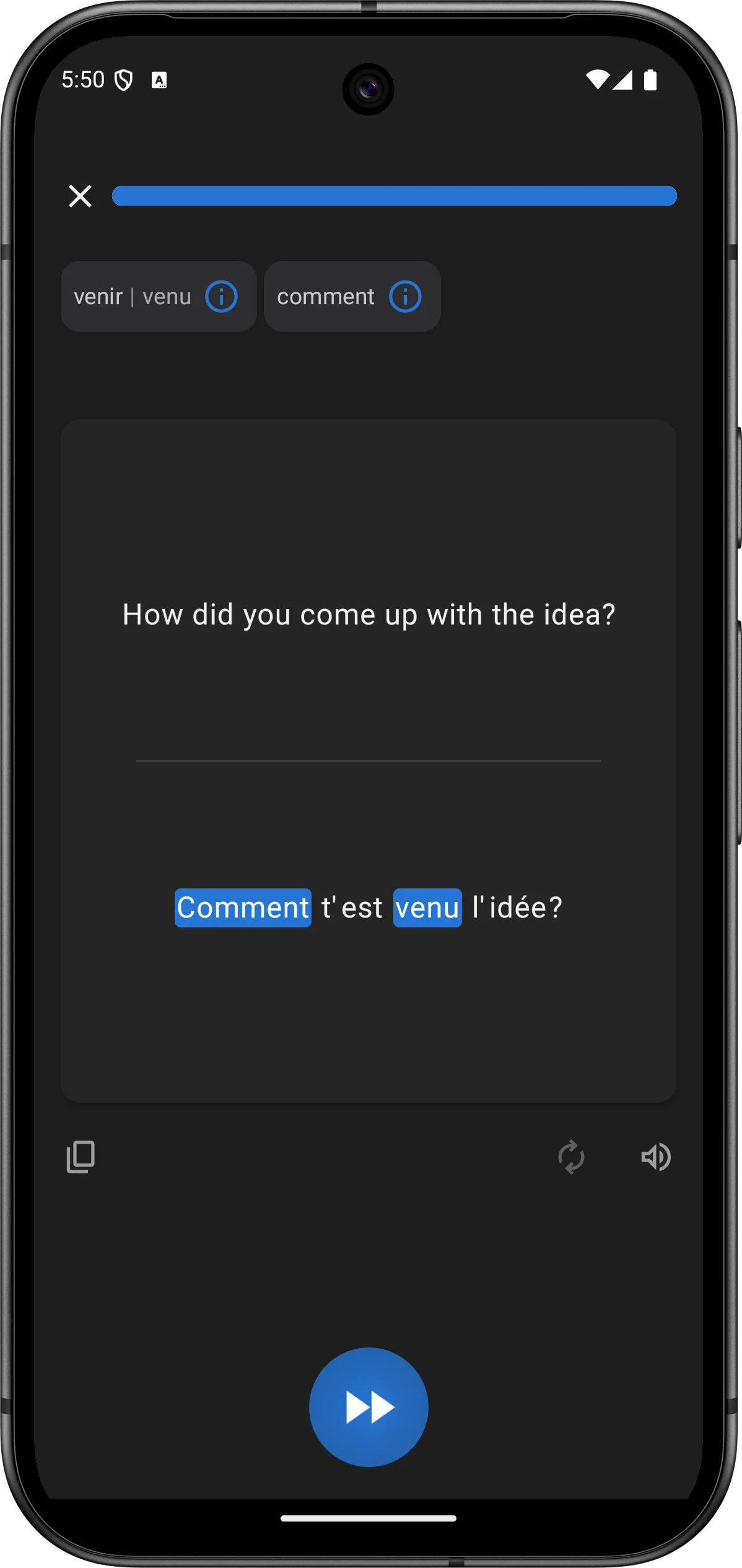
Use that direction when a word looks familiar in French but is difficult to retrieve yourself. If your goal is a conversational exchange rather than sentence recall, give conversation its own practice time.
MosaLingua’s broader tools may be useful for that different task. Vocaber’s emphasis remains the vocabulary review itself.
Which Should You Choose?
Choose MosaLingua if you want prepared vocabulary and phrase cards plus access to a broader set of learning activities. Explore the current offer to see which tools you would actually use.
Choose Vocaber if you already know basic French and want fresh sentence practice without assembling your own deck. Its focus is reviewing multiple words together, marking them individually, and keeping the flow fluid.
You do not need to duplicate every vocabulary review across two apps. Pick the main workflow you enjoy, then pair it with reading, conversation, or a French podcast for intermediate learners.
The Verdict
MosaLingua offers prepared vocabulary cards and a wider toolkit. Vocaber concentrates on fresh, adaptive sentence reviews.
If you want the words you need to practice brought together in context, with a quick check and a separate schedule for each word, try Vocaber.
Vocaber is available on Android. Check Google Play for current subscription terms and availability.

For other approaches, explore our French learning app comparison, Vocaber vs Anki, and Vocaber vs Memrise.