Vocaber vs Anki: Which Is Better for French Vocabulary?
Anki gives you a toolkit for building your own vocabulary practice. Vocaber gives you a French vocabulary workflow built around sentences.
Both use spaced repetition. Both can put words in context. The real difference is what gets reviewed: a card you have prepared, or individual words brought together in a fresh sentence.
Choose Anki if you want control over your material, card design, and review settings. Choose Vocaber if you already know some French and want to spend your study time reviewing vocabulary rather than building a deck.
Vocaber vs Anki at a Glance
| Anki | Vocaber | |
|---|---|---|
| Main approach | Create or import flashcards | Practice French vocabulary in sentences |
| What is scheduled | Each card | Each vocabulary word |
| Sentence context | Add sentences to your cards or choose a sentence deck | Due vocabulary is combined into fresh review sentences |
| Review feedback | Rate your recall of the card’s answer | Check the translation and mark unfamiliar words individually |
| Recognition and recall | Configure different card types, including reverse cards | Input practice and reverse-direction output practice |
| Customization | Custom fields, templates, media, and desktop add-ons | A prepared sentence-based review workflow |
| Best fit | Learners who want to choose and organize their own material | French learners who know the basics and want focused vocabulary growth |
| Cost model | Free desktop and AnkiDroid; paid AnkiMobile for iOS | Subscription; check current terms on Google Play |
Anki’s official overview describes its customization, media support, and platform options. Its getting-started guide explains cards, notes, and review intervals.
What an Anki Review Looks Like
With a basic vocabulary card, you might see:
Front: voisin
Back: neighbor
Recall the answer, reveal it, and rate how well you remembered. Anki uses your response to schedule that card again.
But Anki is not limited to isolated words. You can include a sentence, translation, recording, or image. You can also make cloze cards that hide part of a sentence. Anki’s own editing guide recommends learning language in context.
That flexibility is the appeal: you decide what belongs in your collection. A sentence from a book, a phrase from a conversation, or a difficult spelling can become a review item.
What a Vocaber Review Looks Like
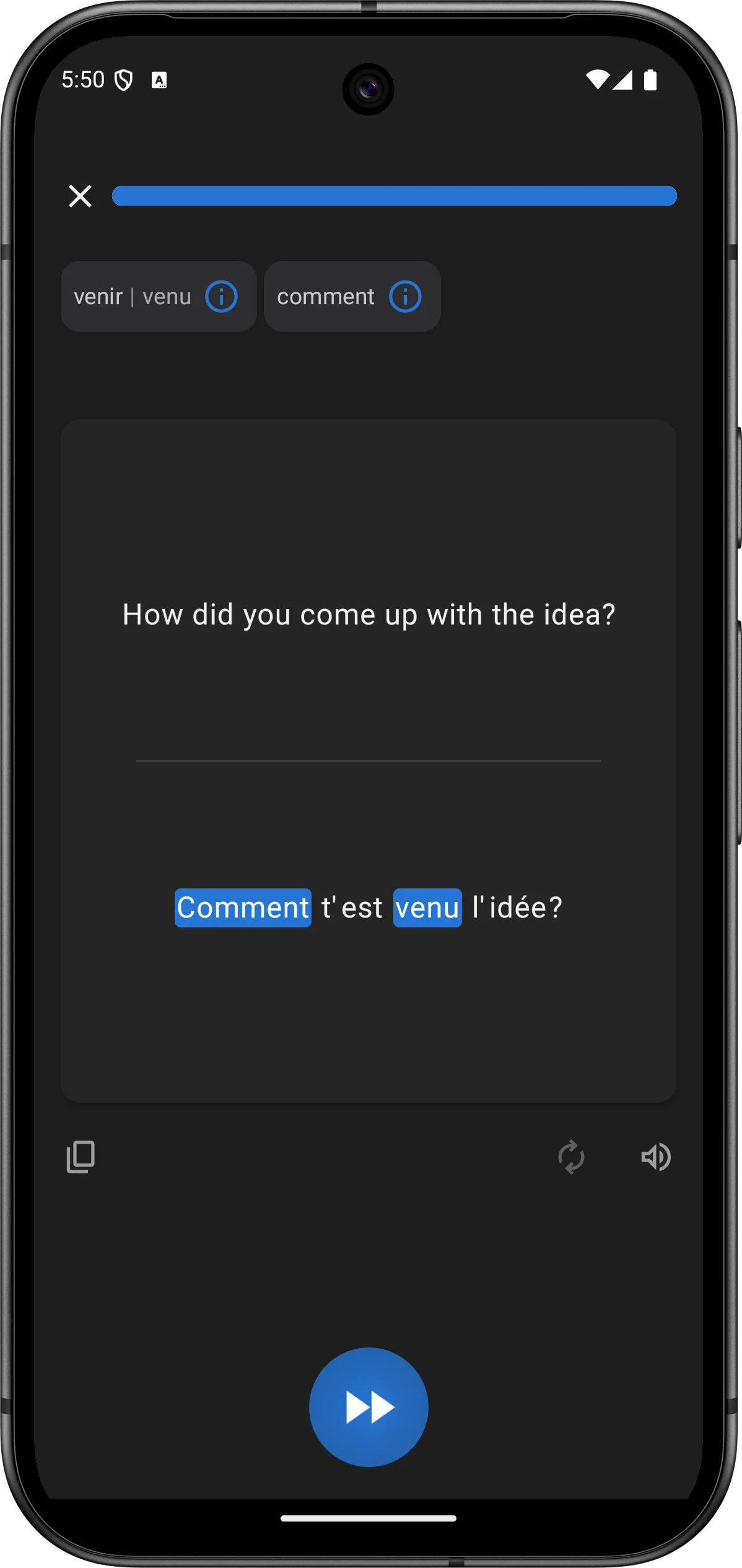
Vocaber starts with the vocabulary that needs practice and brings several words together:
Nous avons marché jusqu’à la maison avec notre voisin.
We walked to the house with our neighbor.
Read the sentence, check its meaning, and tap the words you did not know. Perhaps maison was easy, but voisin was not. Their review schedules remain separate.
The sentence is the context, not the scheduled item. The next review can place the vocabulary in a different sentence instead of returning to a fixed card.
Output practice reverses the direction: start with an English prompt and try to produce the French sentence before revealing the answer.
Sentence Cards vs Fresh Context
A well-made Anki sentence card gives a word a useful setting. With a conventional fixed card, that setting returns whenever the card is due. You can edit it or add more examples, but choosing and maintaining those examples is part of managing the deck.
Vocaber takes a different approach: keep the word’s review history and change the sentence around it. Several due words can share one exercise without sharing one recall rating.
This is the reason to consider Vocaber even if you already use sentence cards. You are choosing a different review workflow, not simply adding sentences to flashcards.
How Much Setup Do You Want?
Anki can be quick to start with a shared deck. Building a personal collection takes more decisions: which material to include, what the prompt should test, and when a card needs editing.
That work can be worthwhile if your vocabulary comes from a particular novel, profession, or course. Your deck can follow exactly what you are studying.
Vocaber is for the opposite preference: open the app and practice French vocabulary through prepared sentence exercises, without designing card templates or assembling a deck.
Spaced Repetition: Cards or Words?
Anki’s deck options give you control over review behavior, including FSRS, daily limits, and desired retention. It is a strong choice if you want to configure your study system.
Vocaber’s distinction is how reviews are presented. Individual words retain their schedules while appearing together in sentences. You assess the words you missed rather than treating the whole sentence as one remembered or forgotten item.
Both approaches still require honest feedback. Revealing an answer and thinking “that looks familiar” is not the same as recalling it independently.
When Anki Is the Better Fit
- You want to study vocabulary you select from your own reading, lessons, or conversations.
- You enjoy tailoring prompts, templates, audio, and images to your needs.
- You want one review system for languages and other subjects.
- You need a free desktop or Android flashcard tool.
We publish free French Anki decks ourselves, including noun gender and diacritics practice. Anki can be an excellent tool when the material and workflow suit you.
When Vocaber Is the Better Fit
- You already understand basic French sentence structure, but vocabulary keeps slowing you down.
- You want to review multiple words in context without creating the review material yourself.
- You prefer fresh sentences to repeatedly encountering the same example card.
- You want input and output practice in a ready-to-use French vocabulary app.
See the Vocaber walkthrough for more about the review flow.
Do You Have to Choose Just One?
No. You could use Vocaber for regular sentence-based vocabulary practice and keep a small Anki deck for specialist terminology or spelling problems. Give each tool a clear purpose rather than duplicating every review in both.
Whichever you choose, make room for French outside the review queue. Try a podcast for intermediate learners, read something you enjoy, and notice which words you can now understand without stopping.
The Verdict
Anki is the flexible toolkit. Vocaber is the focused French vocabulary workflow.
If choosing your own material and controlling the cards matters most, use Anki. If you want to open an app and review several words in fresh sentences, try Vocaber.
For other approaches, explore our French learning app comparison or Vocaber vs Clozemaster.