Vocaber vs Pimsleur: Spoken French Practice or Swift Vocabulary Review?
Do you want to spend your next session responding aloud, or work through the French words that keep slowing you down?
Pimsleur builds its core lessons around listening and speaking. Vocaber focuses on vocabulary in fresh sentences, with a swift review flow and an independent schedule for each word.
Both ask you to remember rather than simply look at an answer. The difference is an audio-led course versus self-paced vocabulary review shaped by what you know.
Vocaber vs Pimsleur at a Glance
| Pimsleur | Vocaber | |
|---|---|---|
| Main activity | Listen to conversational lessons and respond aloud | Read sentences, check meaning, and mark unfamiliar words |
| Session format | Core audio lessons of approximately 30 minutes, which can be split into sittings | A continuous, self-paced flashcard flow |
| Recall | Spoken responses before hearing the model answer | Understand French, or try to produce it from an English prompt |
| Repetition | Graduated Interval Recall built into the course | Individual spaced repetition schedules for vocabulary words |
| Review context | Conversation-based course material | Fresh sentences combining several words that need practice |
| Other practice | Reading lessons and Premium tools such as flashcards and Voice Coach | Input and output vocabulary practice |
| Best fit | Learners who want audio-led speaking and listening practice | French learners who know the basics and want focused vocabulary growth |
Pimsleur’s FAQ explains lesson length, reading lessons, and plan differences. Its method overview describes recall and repetition, while its French course page lists current practice features.
What Pimsleur Is Designed to Do
Pimsleur’s conversational lessons give you prompts, time to respond, and a model answer. You practice retrieving language through speech rather than only recognizing it on a screen.
Its method combines Graduated Interval Recall, which brings material back over increasing intervals, with the Principle of Anticipation: try to respond before hearing the answer. Course vocabulary is introduced in conversation, with an emphasis on establishing a usable core.
That makes it a relevant option if you want guided oral practice and are willing to speak during the session. Simply playing a lesson in the background is different from actively answering its prompts.
More Than Audio Alone
Pimsleur also offers reading lessons, and its Premium features include flashcards, quizzes, interactive exercises, and pronunciation feedback through Voice Coach.
The audio course remains the starting point, but the current product gives you other ways to revisit the material. If written practice matters to you, compare the actual plan features rather than assuming Pimsleur has none.
What a Vocaber Review Looks Like
Vocaber starts with vocabulary that needs practice and brings several words together:
Nous avons attendu le train pendant une heure.
We waited for the train for an hour.
Read the sentence, try to understand it, and reveal the translation. If train is easy but attendu or heure is unfamiliar, mark those words individually.
Each word keeps its own history. You do not need to treat the whole sentence as one correct or incorrect response.
As your feedback changes the words’ schedules, the vocabulary due for future practice changes too. Fresh sentences bring those words into context without turning one example sentence into a permanent review card.
Audio-Led Pace vs Your Own Review Rhythm
A guided audio lesson sets up a rhythm: listen, respond, and hear the model. That can help you practice answering without spending a long time composing a response.
Vocaber puts the pacing in your hands. Its core loop is:
- Read and try to understand.
- Reveal the meaning.
- Tap the words you missed.
- Continue.
An easy sentence can move quickly. A difficult one can take longer. You are not waiting for the next spoken prompt or completing a typed test just to move forward.
Swift review is about reducing the mechanics between useful encounters with French, not rushing past the difficult parts.
Pimsleur recommends one core lesson a day and allows splitting it into several sittings. Vocaber offers a different unit of practice: keep working through sentence reviews for the time you have available.
Adaptation at the Word Level
Repetition alone is not the whole distinction. In Vocaber, multiple words share a context without sharing a review result.
You might know the noun immediately, hesitate over the verb, and forget another word entirely. Marking those differences lets their review schedules diverge.
The result is a fluid flashcard flow: vocabulary that needs attention helps shape later sentences, while the context changes around it. You do not have to build a deck or manually replace examples to get fresh sentence practice.
See the Vocaber walkthrough for more about input and output review.
Which Kind of Recall Do You Need?
Pimsleur’s spoken prompts are useful when responding aloud is the activity you want to practice. Its Voice Coach adds a separate way to work on pronunciation.
Vocaber’s output practice starts with an English prompt. Try to produce the French sentence, reveal the answer, and identify which words caused difficulty.
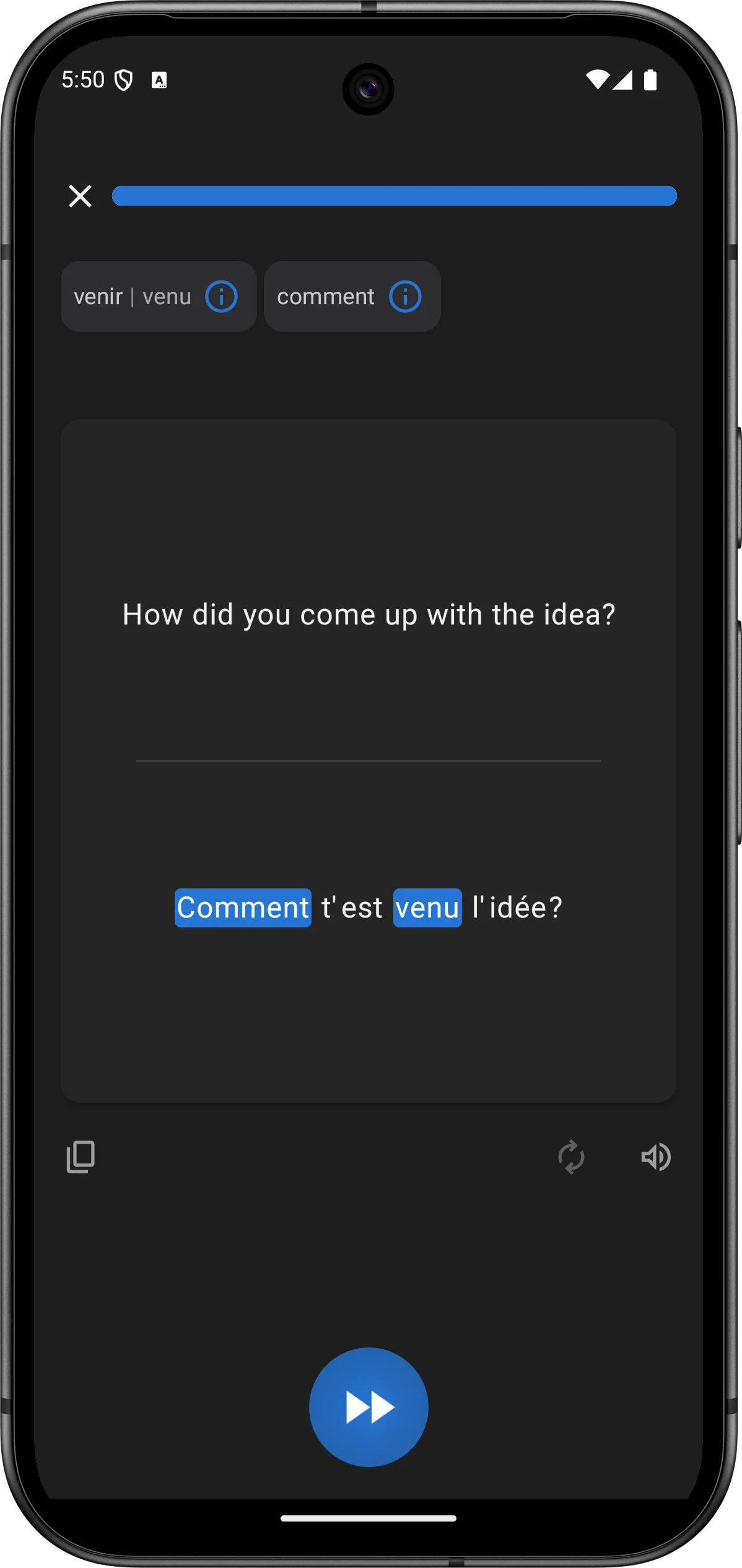
That is a different task from pronunciation scoring. If you retrieve a word easily but struggle with its sound, give pronunciation its own practice time. Our free French pronunciation tool can help you explore French vowels.
When to Choose Each App
Choose Pimsleur if you want a guided speaking-and-listening routine, especially when you can give spoken responses and prefer audio-led instruction.
Choose Vocaber if you already know basic French and want to expand vocabulary through swift, self-paced sentence reviews. It is designed for learners who want to check meaning, identify unfamiliar words, and keep moving without assembling their own study material.
Use both for different jobs if oral course practice and dedicated vocabulary review each address a real need. Leave time for French outside the apps too: a podcast for intermediate learners, reading, or conversation.
The Verdict
Pimsleur gives you an audio-led course. Vocaber gives you fluid, adaptive French vocabulary review.
If vocabulary is your immediate obstacle and you want fresh sentences at your own pace, try Vocaber. It is available on Android; check Google Play for current subscription terms and availability.

For other approaches, explore our French learning app comparison, Vocaber vs Babbel, and Vocaber vs Rosetta Stone.