Why French Isn’t as Hard as You Think
French culture can win you over instantly - warm croissants, crispy baguettes, red wine, and that unmistakable Parisian charm. But what happens when you want to order your favorite macarons in fluent French? The idea of learning the language may seem intimidating, yet millions of people around the world prove that French is far from impossible.
This article brings together insights from language learners, forum discussions, and expert commentary to explain what truly makes French challenging, what makes it surprisingly simple, and how to learn it effectively.
Is French Actually Difficult?
French has a reputation: elegant, melodic, and… supposedly hard. The truth is more balanced. Around 80 million people speak French as their native language, but over 250 million speak it in total - meaning the majority learned it as a second language. If so many can master it, difficulty is clearly relative.
French is considered one of the easier languages for English speakers because of thousands of shared words and similar grammar structures. But it still comes with its own rules, patterns, and “traps” that need some patience.
Learners often describe French as not the hardest, not the easiest… simply different.
The U.S. Foreign Service Institute (FSI) classifies French as a Category I language for English speakers, meaning it belongs to the group of “easier” languages that usually require around 600-750 hours of study to reach professional working proficiency.
This often gets quoted as a definitive measure of how hard French is, but the assessment only reflects the needs of career diplomats in intensive training programs. It does not account for individual learning styles, personal motivation, exposure to the language, or the fact that most learners aim for conversational fluency rather than advanced professional mastery.
For many people, French takes less time, feels more intuitive, and becomes manageable much earlier than the FSI scale suggests.
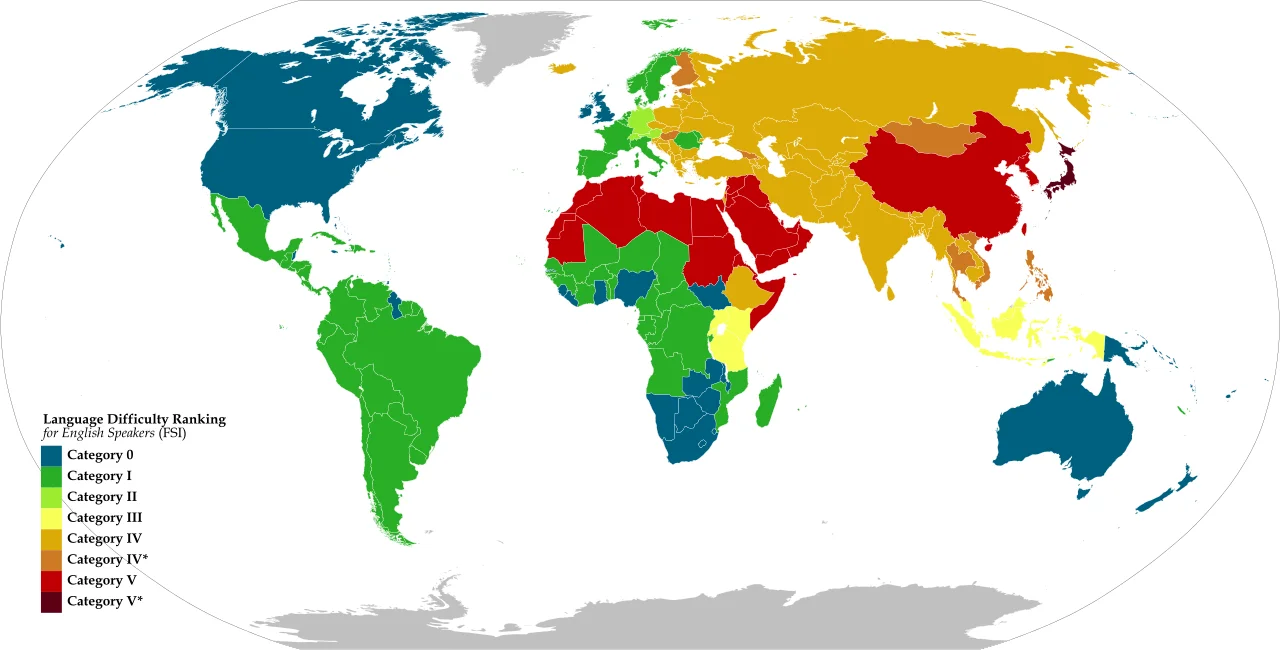
Language Difficulty Ranking for English Speakers (FSI). Nagihuin, CC BY-SA 4.0, via Wikimedia Commons. Data source: American Foreign Service Institute.

What Makes French Challenging?
Pronunciation
This is the feature that intimidates learners the most. French includes:
- nasal vowels unfamiliar to many learners,
- the guttural French “r,”
- liaison rules that connect words in speech,
- and fast, fluid pronunciation.
As many learners note, understanding spoken French can be hard simply because French people speak quickly and blend sounds.
Grammar and Conjugation
French grammar is full of patterns but also exceptions. Among the more challenging areas:
- verb conjugations with numerous forms,
- eight main verb tenses (plus additional subjunctive and conditional forms),
- gendered nouns with no universal rule.
Some learners find these systems logical; others find them overwhelming at first. Most agree that grammar becomes easier once patterns start to repeat.
Syntax
French sentence structure is strict. Word order, pronoun placement, and agreement rules can initially confuse learners who come from languages with freer structures.
Numbers
French numerals can feel illogical for beginners:
- 70 = “60 + 10”
- 80 = “4 × 20”
- 90 = “4 × 20 + 10”
Once memorized, this becomes second nature - but it requires practice.
Fun fact: Belgian/Swiss French variants use a different numeral system, which is more straightforward.
| Number | Standard French | Belgian/Swiss French |
|---|---|---|
| 70 | soixante-dix (sixty-ten) | septante |
| 80 | quatre-vingts (four-twenties) | quatre-vingts |
| 90 | quatre-vingt-dix (four-twenty-ten) | nonante |
| 71 | soixante et onze | septante et un |
| 92 | quatre-vingt-douze | nonante-deux |
Dialects and Speed
Regional accents differ significantly, and some dialects within France can sound almost like separate languages. Learners may also struggle with fast speech and idiomatic expressions.
What Makes French Easier Than You Think
Clear Reading Rules
Despite the myths, French spelling is more consistent than English. Once you learn the reading patterns, you can pronounce most words correctly from their written form.
Logical Structure
Learners often describe French grammar as a construction set: once you know the core pieces, you can build endless sentences. Many older textbooks remain usable because the language has barely changed in 200 years.
Shared Vocabulary with English
Up to 40% of English vocabulary has French roots. Words like restaurant, information, position, culture, and important make vocabulary learning much easier.
Adults Learn It Well
Contrary to the myth that languages are easier only for children, adults:
- learn faster through logic and association,
- notice patterns more easily,
- and benefit from conscious practice.
When Does French Start to Feel Easier?
Beginners usually progress quickly: colors, numbers, greetings, simple phrases. The challenging phase comes later, when vocabulary expands and grammar becomes more complex. Many learners struggle at the moment when all rules need to be applied simultaneously.
But once you pass that “plateau,” things click into place:
- grammar feels intuitive,
- pronunciation improves with exposure,
- vocabulary grows naturally through context.
There are no shortcuts - only consistency and motivation. But those who persist often find that French becomes increasingly enjoyable.
So, Is French Hard?
French has its complexities - pronunciation, grammar, and listening challenges - but none are insurmountable. The language rewards consistency and curiosity. With steady practice and exposure, French becomes not a burden, but a pleasure.
Learning French is less about memorizing rules and more about enjoying its flow, rhythm, and beauty. Millions have succeeded; you can too.