Why Audio Should Be Your First Step in Learning a Language
If you’re beginning a new language, starting with audio gives you faster, more practical results than relying on textbooks or written exercises. Listening forms the base on which all other skills rest.
Audio Develops Multiple Skills at Once
Many languages have spellings that no longer match their pronunciation. Relying on text first often leads to incorrect mental models that are difficult to undo. Audio removes this problem by giving you the real spoken shape of the language from the start.
Speech moves quickly and varies from person to person. Because listening is usually the most difficult skill to master, tackling it early prevents the common gap between reading ability and real-time comprehension.
Reading targets only visual recognition. Audio develops:
- Attentive listening
- Clearer pronunciation
- Natural rhythm
- Understanding of everyday usage
A word isn’t truly learned until you can recognize it when spoken.
Audio Fits Easily Into Daily Routines
Students who study mostly through text often freeze when they finally hear the language at full speed. Audio gets you accustomed to natural pacing, connected speech, and the flow of conversation - making your first exchanges far less intimidating.
Starting with written forms invites guessing. Audio prevents those early mistakes from taking root by giving you a correct model from the start.
You can make progress while commuting, cooking, exercising, or walking. This flexibility encourages consistency, which matters more than any single study method.
Spoken Language Is the Original Form of Language
Long before writing systems were invented, humans relied entirely on speech. Writing came later as a tool to store and transmit what people were already saying. Beginning with audio aligns your learning with how language actually functions in daily life.
For most of history, fluency had nothing to do with literacy. Even in the 19th century, a large share of the French population couldn’t read or write, yet they spoke French naturally. This pattern appears across cultures: people learn to speak by listening to the language used around them, not by studying its written form.
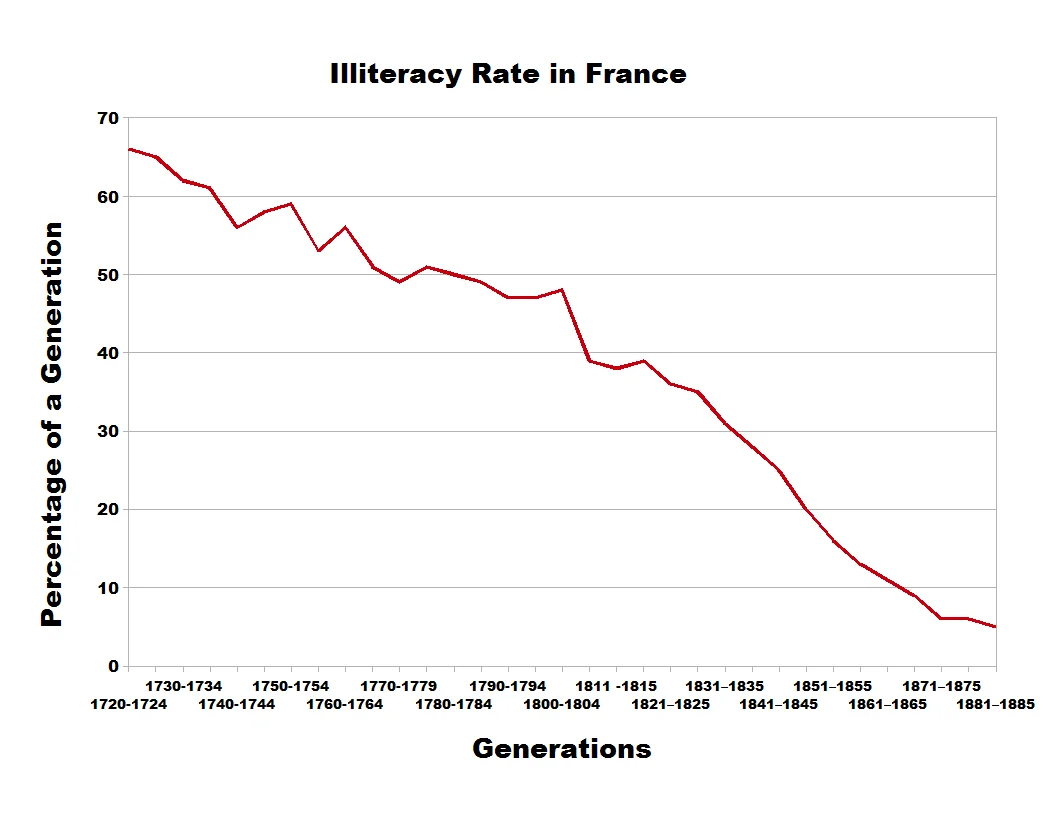
Illiteracy rate by 5-year generations in France (1720–1885). Gedefr, CC BY-SA 3.0, via Wikimedia Commons. Data source: J. Houdailles & A. Blum, “L’alphabétisation au XVIIIe et XIXeme siècle. L’illusion parisienne,” Population, n°6, 1985 (1985 INED survey and 1901 census).

Historical Perspective
French illustrates why starting with audio makes sense. It began as a spoken evolution of Latin and existed primarily as speech for centuries. When Old French finally appeared in writing around the 9th century, spelling varied widely and reflected what scribes heard at that time.
As the language continued to evolve, pronunciation shifted while spelling stayed put. Silent letters that puzzle learners today are the remnants of sounds that disappeared long ago.
The 17th-century standardization overseen by the Académie Française froze spelling even further. The written form became a cultural ideal - not a mirror of how people actually spoke. Modern French spelling therefore represents history, not current speech.
For learners, this means that reading can give a distorted first impression of how the language sounds. Audio, not orthography, provides the more reliable guide.
Ways To Practice Listening
A great way to practice listening is with podcasts. Here we complied lists of high-quality pocasts that you might find interesting: