A Brief History of the French Language
Overview
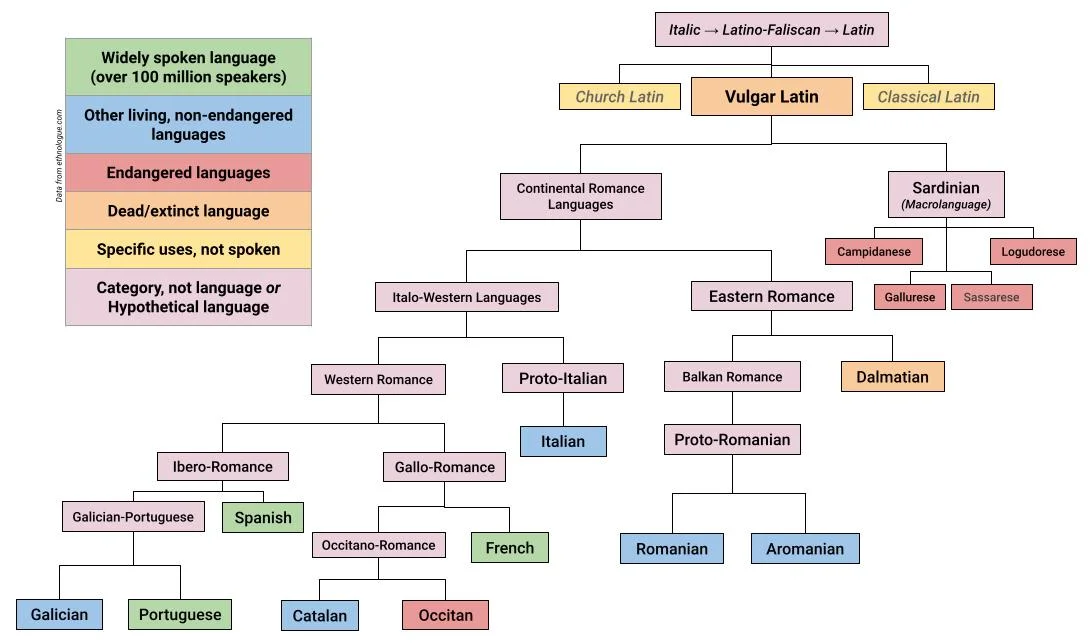
French is part of the Romance family of languages, which all descend from Latin - the language of ancient Rome. Modern French is the outcome of nearly two thousand years of linguistic evolution, usually divided into four broad stages: Old French (9th–13th centuries), Middle French (14th–15th centuries), Early Modern French (16th–18th centuries), and the Contemporary period.
Latin Roots in Gaul
When Gaul (modern-day France) was conquered by Julius Caesar in the 2nd century BCE and became a Roman province, Latin spread throughout the region. Soldiers, traders, and administrators brought it to the Celtic population. Over time, the spoken form of Latin - Vulgar Latin - took hold and began to change. Sounds shifted: stressed vowels turned into diphthongs (flore → fluore), u became [ü], and words such as mare evolved into mer. Final unstressed vowels disappeared, and consonant clusters were simplified. In grammar, only two noun cases survived: the nominative and a single oblique case that replaced the others.

Gallia 58 BC. Feitscherg, CC BY-SA 3.0, via Wikimedia Commons.

Old French Emerges
Between the 5th and 9th centuries, this Vulgar Latin mixed with Germanic languages spoken by invading tribes. After several centuries, Latin reasserted dominance, and by the 9th century, a distinct French language had taken shape alongside a growing French identity. Old French developed two main dialect zones: the northern dialects (influenced by Germanic speech) and the southern dialects, known collectively as Provençal (closer to Latin). The Oaths of Strasbourg (842 CE) is the oldest surviving text in Old French. Eventually, the northern dialect centered on Paris and the Île-de-France became the basis for the national standard.
Old French experienced major sound changes: many diphthongs disappeared (faire → fere), nasal vowels emerged, and consonant sounds were simplified. Spelling increasingly reflected Latin origins instead of actual pronunciation. Articles appeared for the first time, noun endings disappeared, and word order became more rigid. Verbal patterns were already quite similar to those of modern French.
Middle French Reforms
In the Middle French era (14th–15th centuries), phonetic simplification continued. Unstressed vowels weakened or vanished (seur → sur → sûr), nasal sounds merged, and spelling leaned even more heavily on Latin models (formacion → formation). The article system became consistent, and new forms such as the partitive articles (du, de la) entered use.
Standardization
By the 16th century, French had been declared the kingdom’s official language. Administrative reforms and the spread of education unified speech and reduced regional differences. In the 17th and 18th centuries, during France’s height as a European power, French achieved international prestige as the language of diplomacy and culture. Speech patterns stabilized with stress falling on the most important words, and spelling became conservative, often preserving historical forms. Grammar assumed its current shape, with clear gender markers (-e for feminine), a developed article system, and flexible personal pronouns that could stand alone (Moi? Rien.) or attach to verbs (je hais). A fixed word order became a defining trait, giving French its logical and analytical structure.

Regional languages in 1550 France. Aoleuvaidenoi, CC0 1.0, via Wikimedia Commons.

Modern Evolution
In modern times, the language has continued to simplify. Everyday speech increasingly favors straightforward grammar and pronunciation. Compound tenses such as the passé composé have replaced older literary forms like the passé simple, and strict rules of tense agreement are often relaxed in conversation.
Through centuries of gradual change, French has become the precise and elegant language known today - and still evolving.

Countries where French is native, official, or administrative. aaker, CC BY-SA 4.0, via Wikimedia Commons.

References
- Peter Rickard, A History of the French Language (Cambridge University Press, 1989).
- Rebecca Posner, The Romance Languages (Cambridge University Press, 1996).